Glossary of Terms
Conglomerate -
a thing consisting of a number of different and distinct parts or items that are grouped together. A corporation Made up of several independent businesses. smaller companies involved support the widespread goals and objectives of the parent company involved.
Example - Fox, (Sky TV)
Independent Company -
a company that is not publicly traded on the stock market and is generally owned by a very small group of individuals. Free to design and do whatever they want.
Joint venture - When one media company works with another on a project that is mutually beneficial.
Distribution - How a branch reaches an audience and market/promotion.
Examples - Rogue Pictures, Working Title Pictures
Public Service Model -
Company that delivers services aimed at supporting public interests.
Example - BBC studios
Mise en Scene - Placing in the scene.
Setting - where the film/tv show is set (location).
Diegesis - The fictional world (time and place) of the narrative.
Verisimilitude - How this real world appears.
Diegetic Effect - Diegesis + Verisimilitude.
Props - any object used or held by and actor to add to the story.
Hero prop - Prop that has to look like it is functioning on set.
Staging - The process of selecting, designing, adapting to, or modifying the performance space for a film
Blocking - position of actors on the screen/stage.
Proxemics - How close things are to other things on set. Spacial relationships.
Costume - The clothing that a character wears. This can be stereotypical.
Makeup - used to prevent their skin from looking shiny, produce a matte colour.
Prosthetic makeup - used to change a character/actors appearance.
Figure expression - Use of facial expression to convey emotions.
Figure movement - how things move on screen, important in creating spectacle in action movies and musicals.
Cinematography -
Shot types -
Close shots - extreme close up, close up, medium close up, big close up. These are for showing detail or intimacy.
Medium shots - Medium close up, Medium long shot/cowboy, from knees up, Medium mid shot from waist up. These are for showing locations, and still close enough to show expressions.

This is a scene from the Jason Bourne films. This is a medium long shot, as it is almost taken from the knees up

This is a scene from Pirates of the Caribbean. This is a medium close up shot, where it shows jack's emotion
Wide shots - long shot, entire subject in frame, Extreme long shot, further away from long shot, master shot, getting everyone in the shot, establishing shot, long or extreme which creates a location. These are for showing action and creating spectacle and establishing a location.
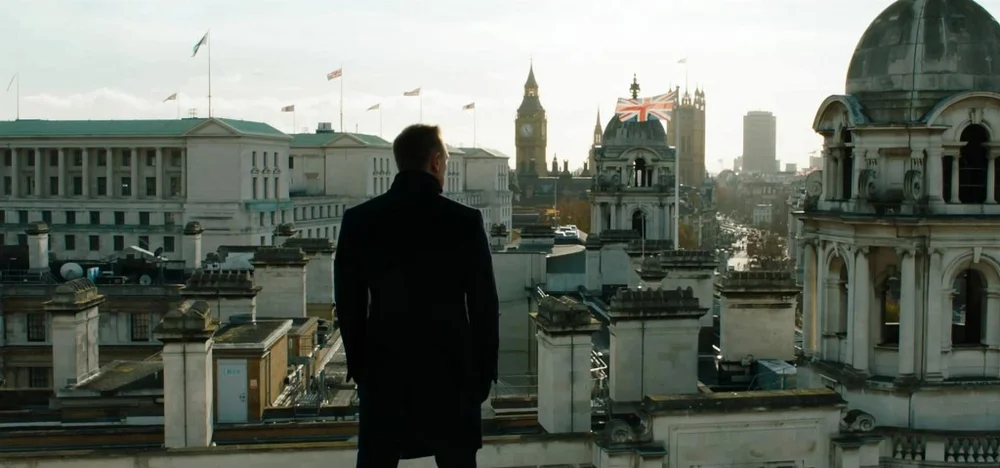
This is a good example of a wide shot, as the entire background of the scene is in view. It is also a medium long shot, as it comes up from the knees.
Camera angles -
Composition and aspect ratio -
Lighting -
Colour -
Lens type -
Focus -
Camera Movement -
Connotation - Something that relates to something else, maybe a feeling or a place.
Camera Mounts -
Handheld camera - This camera is held by someone and the movement that is recorded is natural. This is usually used to create a closer feeling with the protagonist as we live the film through their view.
Tracking/ dolly shots - A track with a buggy on it, and it moves along the track to track a certain object.
1. Shot -> Reverse -> Shot.
2. Graphical Match.
3. Eyeline Match.
4. 180* Shot Rule.
5. Directional Continuity.
Roland Bart - Cultures and Society have signs in them. Denotation and connotation - semiotics
Encoding/Decoding Model - audiences have different meanings based on their own culture, upbringing and political standpoints. There are three positions and audience may take. (Hall, 1980)
Preferred, Negotiated and Oppositional.
Gauntlett's Identity theory -
While everyone is individual, people tend to exist in larger groups who are similar to them. Media does not create identities but rather reflects them.
Laura Mulvey's male gaze theory -
The belief that the media industry is strongly aimed to male interests. This is specifically the objectifying and sexualising of women. This appeals more to males as they are much likely to look at it. used as a 'point' for males to watch TV and film.
Cohen's theory of moral panics -
Moral panic is defined as a public mass movement, based on false and exaggerated interpretations that exceed the actual threat that society faces. This is usually caused by news and media companies, and results in more social control.
Comments
Post a Comment